Skills-Based Hiring: How to Build a Fairer, Sharper Hiring Process
A practical guide to separating essential from desirable skills, assessing candidates fairly, and scoring them against a consistent framework.
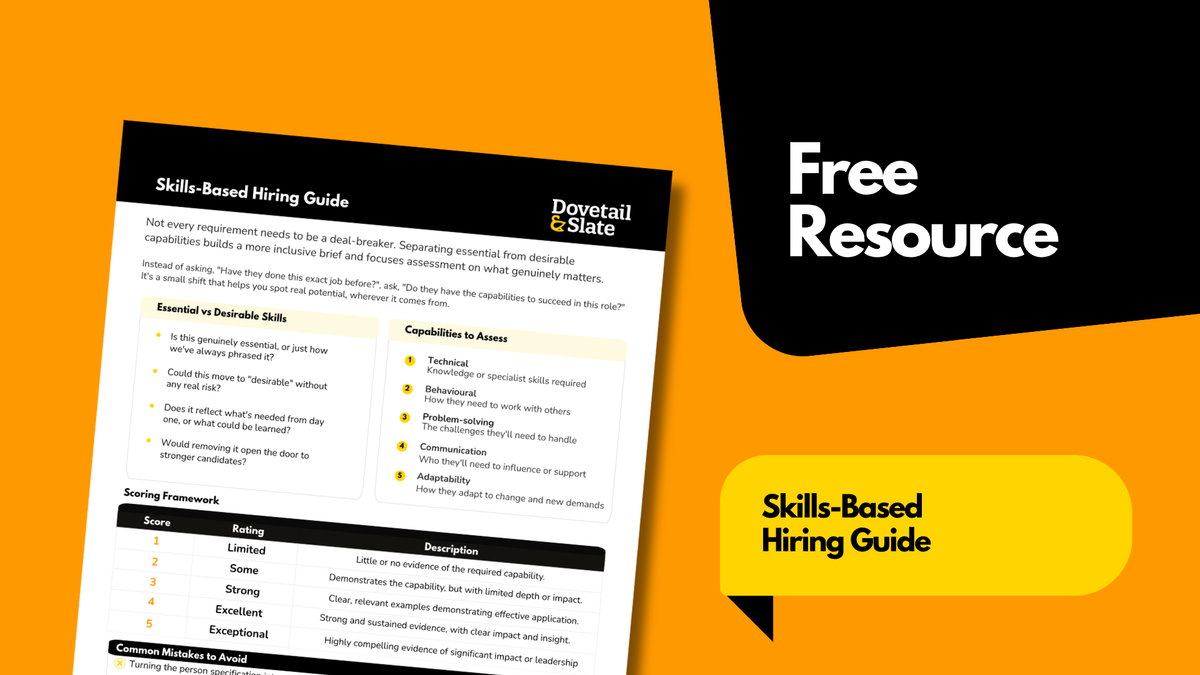
Not every line on a person specification needs to be a deal-breaker. When you separate what's genuinely essential from what's just nice to have, you write a more inclusive brief - and you focus your assessment on what actually matters.
The shift is simple. Instead of asking "Have they done this exact job before?", ask "Do they have the capabilities to succeed in this role?" That one change opens the door to candidates who bring real potential, even if their CV doesn't tick every box.
Essential vs desirable: the four-question test
Before you post a role, run every requirement through these questions:
- Is this genuinely essential, or just how we've always phrased it?
- Could it move to "desirable" without any real risk?
- Does it reflect what's needed from day one, or what could be learned on the job?
- Would removing it open the door to stronger candidates?
If a requirement doesn't hold up, cut it or reclassify it. A leaner, more honest brief attracts a wider, and often stronger, field of applicants.
Five capabilities worth assessing
Skills-based hiring works best when you know exactly what you're scoring. Focus on:
- Technical - the knowledge or specialist skills the role actually requires.
- Behavioural - how the person needs to work with others.
- Problem-solving - the challenges they'll be expected to handle.
- Communication - who they'll need to influence or support.
- Adaptability - how they respond to change and new demands.
A scoring framework that keeps everyone honest
Score every candidate against the same framework, every time. It keeps interviews consistent and decisions defensible.
Score 1, Limited: little or no evidence of the required capability.
Score 2, Some: demonstrates the capability, but with limited depth or impact.
Score 3, Strong: clear, relevant examples demonstrating effective application.
Score 4, Excellent: strong and sustained evidence, with clear impact and insight.
Score 5, Exceptional: highly compelling evidence of significant impact or leadership.
Common mistakes to avoid
- Turning the person specification into a wish list. Every extra "must-have" narrows your pool for no real gain.
- Screening by job title instead of capability. A great candidate's last title won't tell you if they can do this job.
- Confusing confidence with competence. Look for evidence, not polish.
Quick checklist before you brief a role
- Have we identified the genuinely essential capabilities?
- Does our job description focus on impact and outcomes?
- Are candidates scored against the same framework?
- Have we considered potential as well as experience?
Need support with your next hire?
Whether you're recruiting for a school, MAT, college, university, local authority or wider public sector body, we can help you identify the skills that matter most. Get in touch or call 0117 422 9420.
Related Resources
30-60-90 Day Onboarding Framework
A practical framework to help education and public sector employers structure the first three months of a new starter's journey - from day-one expectations through to a genuine sense of belonging by day 90.
Employer Brand Showcasing Impact Guide
A practical guide to helping you communicate purpose, culture and impact in a way that resonates with candidates.
Candidate Experience Interview Checklist
This checklist is designed for hiring managers in Education and the Public Sector who recognise that the interview is a high-stakes "first date." In a competitive talent market, the experience you provide is often the deciding factor for a top-tier candidate. Use this resource to audit your process and ensure every candidate leaves feeling valued, informed, and excited about the prospect of joining your team.